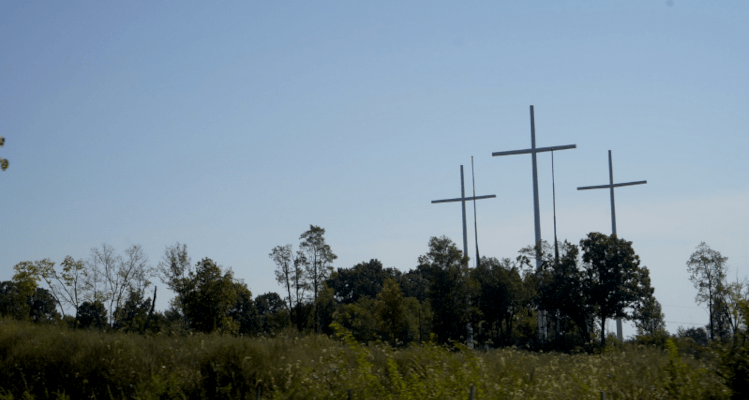
So I tried to write a column about dog rape. I couldn’t do it. Despite my fear of losing the last of my Substack subscribers, going broke, getting evicted from my apartment, and moving in next to the homeless guy who lives outside the doorway of the grocery store across the street, I could not do it. I could not write about dog rape.
As it turns out, I have no “take” on dog rape … well, except that it’s bad. I’m against it, unequivocally. But that’s the extent of my opinion on dog rape.
Also, Thomas Massie. I could not care less. And the Granta AI scandal. And whatever other news is being spewed out into the Internet for obligatory opining this morning.
So I’m posting another excerpt from my book. The book I’m writing about my visit to America, and the seven weeks I spent on the road, tear-assing all around the country with old my friend, Hugo Fernandez, a photographer, and our manic search for what remains of the American spirit. This one is actually an excerpt of an excerpt. I don’t want to piss off my publisher, Arcade Publishing, by posting the entire book online.
The title of this chapter is “The Beast,” but the Beast does not get mentioned in this excerpt … or not expressly in any event. The Beast got mentioned in the course of an event I did in a tent in West Virginia, and it gets mentioned later on in the chapter.
You’re probably familiar with The Beast, but, the odds are, you call it by some other name. We all see the world through the lenses we’re wearing. Which is kind of what this chapter ends up being about.
Anyway, here’s how it begins …
An excerpt from Chapter 5, The Beast.
I decided it was probably best not to burden Hugo with the news of my midnight ride with “Bobby” and his creepy driver. I doubt he would have believed me anyway. I wasn’t sure I believed it myself. In any event, I was in no shape to explain it. My head was pounding from all the Jameson, and my lingering jet lag, and sleep deprivation.
Hugo wakes up at 4:00 A.M. He does this like clockwork, every single day, regardless of what time he goes to bed. Apparently, he has no control over this. He doesn’t set an alarm or anything. He just wakes up, and starts digging around in his luggage, and flushing the toilet, and taking a shower, or whatever it is he does at home when I’m not lying there in the same hotel room savagely hungover and trying to sleep. This was our first hotel room together, the first of many more to come. As I was about to find out, this pre-dawn digging, flushing, and extended showering activity typically goes on until 6:00 A.M., when the hotel restaurant or the local corporate breakfast establishment opens for business.
That breakfast establishment is usually Starbucks. You can walk in there, or drive through the drive-thru, and purchase an assortment of exotic coffees, like “Starbucks 1971 Roast” and “Starbucks Sun-Dried Ethiopia Highlands,” which you can attempt to consume through the plastic sip-lid of your enormous to-go cup while enjoying a “Chocolate Pistachio Loaf,” or “Strawberry Matcha Loaf,” or an assortment of other breakfast products that look and taste exactly the same regardless of where you are in America.
Occasionally, as in our hotel in Washington, you are provided with a variety of single-serving coffee-in-a-teabag things that you can heat up an incredibly noisy kettle and prepare in your room at 4:30 A.M. while your roommate is desperately trying to sleep. These single-serving coffee-in-a-bag things come in cheerfully color-coded packaging and have fanciful brand names, like “Ethiopian Breakfast Blend,” “Nicaraguan Roast,” “Macadamia Roast,” “Decaf French Vanilla Roast,” and so on.
America is the epicenter of infinite assortments of individually shrink-wrapped and otherwise excessively over-packaged consumer products with fanciful brand names and memorable logos that no one really needs. Or, OK, some of these products are needful, or arguably needful. Toothpaste, for example. But there are literally hundreds of brands of toothpaste. You walk into the toothpaste aisle at your local Walmart or CVS, and there they are, hundreds of them. Aquafresh. Close-Up. Mentadent. Pepsodent. Tom’s of Maine. Oral-B. Ultra Brite. Sensodyne. Therabreath. Etcetera. There are hundreds of brands of pain relievers. Advil. Tylenol. Exedrin. Celebrex. Midol. Aleve. Unisom Sleep Tabs. Ear Pain Drops. Boil Relief Creme. Sudafed. Ex-Lax. Dulcolax. Aspercreme. Voltaren. Demerol. MS Contin. Roxanol. Percocet. Oxycontin. And the list goes on, and on, and on. The shelves of your local corporate supermarket or megastore are lined with hundreds of brands of processed, ultra-processed, and bio- and genetically-engineered food products. Mass-produced breads. Cheerios. Fruit Loops. Magic Spoon Fruity Protein Cereal. Fritos. Tostitos. Frozen pizza. Instant noodles. Oreos. Snickers. Twizzlers. HoHos. Macaroni and cheese. Orange juice powder. Cheese-It. Coke. Pepsi. Energy beverages. And so on.
Most Americans are inured to the fact that they are no longer living in a democratic society, but, rather, in one big global marketplace, designed, managed, and controlled by corporations. Their lives are a series of interactions with products and services, and advertisements for products and services, and communications regarding products and services. Their interaction with these products and services begins the moment they wake and reach for their phones and continues until the moment they fall back to sleep. Every element of their official reality reinforces their identity as consumers. The feed on their smartphones. Their brand of coffee. Their breakfast products. Their morning news. The make of their vehicles. The personally-selected voice of their onboard GPS navigator. The billboards along the highways they drive, or the streets they walk to their subway stations, the walls of which are festooned with ads. The corporations they work for, and their products and services, and the marketing of their products and services. The dating apps. The social media. The personal proprietary virtual assistants. The omnipresent television screens. A living, breathing, virtual reality, in which everyone is either a potential customer, or a competitor, or coworker, or their boss, or some annoying public-sector bureaucrat. Everything costs. Food. Water. Physical space. Movement. Time. Moment by moment. Frame by frame. The movie running on an endless loop. The perpetual motion machine of the market, a series of ceaselessly spinning wheels, wheels within wheels within other wheels, Ferris wheels, hamster wheels, circuitous flows, going nowhere, turning in the widening gyre, trapping and recycling all energy, consuming and regenerating itself, devouring meaning, devouring America, excreting a simulacrum of America …
Was there still another America out there, beyond the ever-expanding urban sprawl, beyond the cities, the suburban shopping malls, maybe even beyond the reach of the spectacle?
Hugo and I were going to find out.
We were tear-assing up into the Appalachian Mountains, heading for Hillsboro, West Virginia, population approximately two-hundred and fifty. West Virginia was founded in 1863, midway through the Civil War, after it seceded from the state of Virginia. The government of Virginia had long been dominated by the plantation owners in the northeast regions, as their non-voting slaves were counted in the censuses. The farms in the west were mostly family farms. After Virginia joined the Confederacy, the west voted to secede, and joined the Union.
Hillsboro is located in the Little Levels, a level plain in the limestone valley at the southern end of Pocahontas County. It’s just down the road from the official headquarters of the National Alliance, the neo-Nazi organization founded by William Luther Pierce. It’s also the birthplace of Pearl S. Buck, the first woman to win a Nobel Prize for literature. We needed to get there in time to wash up and do a 4:00 P.M. event at the Levels Depot, a combination general store, café, and gas station off the Seneca Trail. Our host, a gentleman named Harley Lennon Squires, had told us to take a left onto Lobelia Road, and then turn right onto a gravel road that didn’t have an official name, and then drive until we saw what looked like the parking area of a non-existent campground, where someone would be waiting to lead us to an isolated off-grid property in the woods, where we would be sleeping for the next two nights. The thing was, we were coming in from the north, instead of the south, as Harley had assumed, so we were trying to reverse his directions, and I was still hungover, and sleep deprived, and Hugo was trying to figure out where we were on the map on the screen of the GPS thing, and I ended up driving us down a road that didn’t go anywhere, and which felt like somewhere a serial killer would take his next victim. So we doubled back, but I ended up on another dirt road that didn’t take us to the non-existent campground parking area, or to Lobelia Road, or anywhere else resembling human civilization. So I found a spot to turn around, and got us out of there, and wound up on a road that felt like it was taking us back to where we started before I got us hopelessly lost, or at least there was some kind of farm, or compound, with cars and trucks in the yard up ahead. Two men in dark suits were standing on the porch of the house, watching us come up the road. They didn’t particularly look like farmers.
“I think it’s probably time to call Harley.”
“You kidding? Do you see any bars on the screen.”
“I have no idea what you’re talking about.”
“Bars. Signal. There isn’t any.”
“Right. Sorry.”
“I’m lost in the hills of West Virginia with a fucking caveman.”
“I know what bars are.”
“Why don’t we just drive up there and ask those Nazis for directions.”
“Keep your voice down. Sound travels out here.”
The Allman Brothers Band started playing.
“Bars!”
I drove us on past the compound, keeping one eye on the possible Nazis. Hugo was desperately trying to call Harley with his phone plugged into the GPS thing. It rang. Finally, Harley answered. He was in some kind of echo chamber. We couldn’t make out a word he said. An extended series of aborted calls and interrupted messages ensued. Somehow, in the course of following ten minutes, as I drove us around in what felt like circles, Hugo got directions from Harley and got us to the road that led to the road that led to the isolated property in the woods.
Harley owns several isolated properties in the woods of Hillsboro, and is acquiring more. He has plans to build a healing center, where people can escape modernity and return to the roots of human life, coexisting with nature, growing their own food, going barefoot as much as possible, and otherwise enjoying being alive. Harley can afford to do all this because he came into a considerable amount of money as a result of being accidentally killed when a massive object struck him in the head on a construction job he found on Craigslist while he was living in his truck in California. He was dead for approximately fifteen minutes before the EMTs resuscitated his heart.
Now, there he was, very much alive, standing out on the lawn of the property, a two-story cabin he’d had built beside what looked like the ruins of a moonshiner’s shack. He limped toward us.
“Welcome, strangers!”
A big black Rottweiler appeared out of nowhere.
“Yikes.”
“That’s Sita. Down, Sita!”
Sita was getting acquainted with my crotch.
“She’s friendly.”
“She’s Kara’s. They’re around here somewhere.”
Hugo had started unpacking the trunk.
“You just made it. We’re on in twenty minutes.”
…
Harley had rented a pavilion tent for our gathering at the Levels Depot. Brandy Codswallow had not informed me of this development, and Harley hadn’t mentioned it, so I was rather surprised and a bit intimidated when we drove up to it. There was a stage, a sound system, portable toilets, complimentary beverages, the whole nine yards. Michelle, Harley’s right-hand woman, was there to greet us and offer us assorted cannabis edibles and drinkables and such. I was working, so I decided to pass. The tent was fairly packed with locals. Who were all these people? Where had they come from? They didn’t look like members of the National Alliance, but it was definitely a right-leaning crowd. I didn’t see any MAGA hats, but several American flags were in evidence. Homemade placards with Charlie Kirk quotes were taped all across the front of the stage. According to the headlines on social media, people were being summarily “cancelled” for failing to appropriately mourn Kirk’s passing. The U.S. State Department had announced that it would penalize foreigners suspected of “praising, rationalizing, or making light of his death.” President Trump was blaming “a radical left group of lunatics” for his assassination, and threatening to have George Soros arrested. Off to my left, the sun was setting all orange and purple behind the Allegheny Mountains. Hugo was taking pictures of it. Michelle was looking up at me as if she had just asked me a question I hadn’t registered. I was conceived in a trailer somewhere in these hills. I don’t know why I remembered that.
Harley was already up on stage. He waved at us. It was time to start.
###
The rest of the chapter is mostly about God, and religion, and the culture war, and so on, and what Harley saw and heard when he was dead, but you’ll have to wait for the book for that. As it turns out, it won’t be published until next year. My recent illness threw us off schedule. But I’m more or less back now, and hammering away at it. I’ll try to post another excerpt or two this summer.
Again, heartfelt thanks to everyone who financed and otherwise supported the road trip, and to all the paid subscribers who hung in there with their support during the last four mostly fallow months.
CJ Hopkins
May 22, 2026
Photo: Hugo Fernandez, Professor of Fine Art and Photography, LaGuardia Community College, CUNY, Long Island City, New York
DISCLAIMER: The preceding essay is entirely the work of our in-house satirist and self-appointed political pundit, CJ Hopkins, and does not necessarily reflect the views and opinions of the Consent Factory, Inc., or its staff, or any of its agents, subsidiaries, or assigns. If, for whatever inexplicable reason, you appreciate Mr. Hopkins’ work and would like to support it, please go to his Substack page, or his Patreon page, or send a contribution to his PayPal account, so that maybe he’ll stop coming around our offices trying to hit our employees up for money. Alternatively, you could purchase his satirical dystopian sci-fi novel, Zone 23, or Volumes I, II, III, and IV of his Consent Factory Essays, or any of his subversive stage plays, which won some awards in Great Britain and Australia. If you do not appreciate Mr. Hopkins’ work and would like to write him an abusive or threatening email, feel free to contact him directly.
 Consent Factory, Inc.
Does getting humped by your uncle’s herd of pure bred Pomerians after a family reunion count as dog rape?
LikeLike